1. Introduction
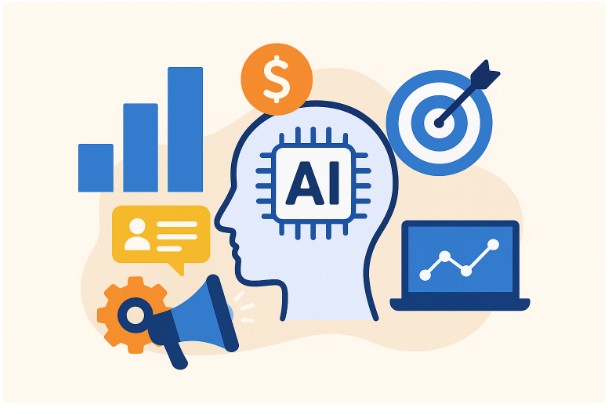
Artificial intelligence (AI) is reshaping the way modern businesses approach marketing, offering smarter strategies, deeper personalisation, and faster execution than ever before. By analysing data in real time, AI helps brands understand customer behaviour, predict trends, and deliver the right message at the right moment. From automated campaigns to personalised customer journeys, AI is making marketing more efficient and impactful. As technology continues to advance, companies that embrace AI are gaining a clear competitive edge.
2. Understanding AI in Marketing
According to a 2025 survey, 88% of marketers now use AI daily (Source) — a clear sign that AI has moved from experimental to essential in marketing workflows. AI in marketing refers to the use of artificial intelligence technologies to improve decision-making, streamline processes, and personalise customer interactions. It combines data-driven algorithms with machine learning models to understand customer behaviour, forecast trends, and automate key tasks.
Core Technologies Behind AI in Marketing
-
Machine Learning (ML):
Helps marketers analyse large datasets, identify patterns, and make informed decisions. ML is the backbone of customer segmentation, lead scoring, and campaign optimisation.
-
Natural Language Processing (NLP):
Enables machines to understand and process human language, allowing for applications like sentiment analysis, chatbots, and personalised content recommendations.
-
Predictive Analytics:
Uses historical data and statistical algorithms to anticipate customer behaviour — from purchase likelihood to churn risk.
Benefits of Integrating AI into Marketing Strategies
- Enhanced customer personalisation
- Increased efficiency through automation
- Improved targeting and campaign performance
- Better insights through real-time analytics
- More accurate forecasting and decision-making
By embedding AI across marketing functions, businesses build more agile, intelligent, and responsive strategies.
3. Core Applications of AI in Marketing
Personalisation at Scale
AI-powered personalisation allows brands to tailor content, offers, and experiences for each individual customer. Instead of broad messaging, AI enables deep behavioural analysis to deliver precisely what users want at the right moment. This AI-powered personalisation boosts engagement, conversions, and long-term loyalty.
Predictive Analytics
Predictive analytics in marketing helps brands identify future buying behaviours, emerging trends, and revenue opportunities. By analysing historical data, AI forecasts which leads are most likely to convert, when customers may churn, and what campaigns will deliver the highest ROI.
Customer Segmentation
Traditional segmentation is limited, but AI clusters audiences based on real-time behaviours, demographics, interests, and buying intent. This leads to highly targeted marketing strategies that resonate more effectively.
Chatbots and Virtual Assistants
AI-powered chatbots use NLP to interact with users in real-time, answering queries, offering product recommendations, and improving customer satisfaction. They reduce support costs while enhancing the user experience.
Content Generation
Generative AI tools can create blogs, product descriptions, ad copies, and social media content at scale. This reduces manual workload and speeds up content production while maintaining quality and relevance.
A 2025 survey by Gartner reveals that of the companies that have adopted generative AI for marketing, 77% use it for creative-development tasks; this rises to 84% among high-performing marketing organisations — indicating a strong correlation between GenAI use and marketing performance.
Campaign Optimisation
AI automatically monitors campaigns, adjusts targeting, tests variations, and allocates budgets to the best-performing ads. This optimisation ensures stronger ROI and more efficient ad spending.
4. Generative AI: The Game Changer
Generative AI represents a revolution in marketing. Unlike traditional AI models that rely on predefined rules, Generative AI systems can create new content, insights, and ideas based on learned patterns.
Real-World Applications
- Automatically generating personalised email campaigns
- Creating ad copy and product descriptions
- Enhancing customer support with conversational AI
- Producing dynamic visuals and multimedia content
Brands across industries are using Generative AI in marketing to accelerate production, reduce creative bottlenecks, and improve message relevance.
Benefits & Challenges
Benefits:
- Faster content creation
- Highly personalised experiences
- Reduction in manual workloads
Challenges:
- Potential for inaccuracies or generic content
- Requires careful oversight to maintain brand tone
- Needs robust guidelines and ethical usage policies
Despite these challenges, Generative AI is becoming a cornerstone of modern marketing innovation.
5. Implementing AI in Your Marketing Strategy
Integrating AI into your marketing ecosystem requires a strategic, phased approach.
Steps to Integrate AI
- Audit existing workflows to identify where automation and AI can add value.
- Define clear goals, such as improving personalisation or reducing manual content creation.
- Choose the right AI tools and platforms based on your business size and objectives.
- Build a data-driven culture by centralising data and ensuring proper data hygiene.
- Upskill your teams to leverage AI effectively and responsibly.
Whether you are deploying chatbots, predictive models, or automated ad systems, partnering with expert providers offering AI development services can streamline implementation and ensure long-term success.
6. Case Studies: Successful AI Marketing Implementations
Amazon
Amazon uses machine learning to power personalised recommendations, which significantly boosts conversions and customer retention. (Source – Amazon News)
Netflix
Netflix leverages predictive analytics to recommend shows and tailor user experiences, drastically increasing user engagement. (Source – argoid.ai)
Coca-Cola
Coca-Cola employs AI and NLP for social listening, allowing real-time understanding of customer moods, trends, and brand sentiment. (Source – DigitalDefynd)
These case studies highlight the massive impact AI can have on customer experiences and business outcomes.
7. Ethical Considerations in AI Marketing
With great power comes great responsibility — and ethical AI usage is essential.
Addressing AI Bias
Biased data results in biased outcomes. Marketers must regularly audit algorithms to ensure fairness and inclusivity.
Transparency & Accountability
Businesses should avoid “black box” models and clearly communicate when AI is being used in customer interactions.
Data Privacy & Security
Protecting user data is not only ethical but legally required in regions like the USA, UK, and Australia. Secure storage, responsible tracking, and compliance with privacy laws (GDPR, CCPA, etc.) are critical.
8. The Future of AI in Marketing
The next 5–10 years will bring even more advanced AI capabilities.
Emerging Trends
- AI-powered video content generation
- Voice-based search optimisation
- Emotion AI for deeper behavioural insights
- Hyper-automated customer journeys
- More sophisticated AI analytics platforms
Predictions
AI will become more autonomous, predictive, and integrated across every touchpoint. Marketers who embrace AI now will be better positioned to compete in the future digital landscape.
9. Conclusion
AI is transforming modern marketing by enhancing personalisation, improving targeting, and automating complex processes. With technologies like machine learning, NLP, predictive analytics, and Generative AI, brands can unlock unprecedented efficiency and customer engagement. As businesses across Australia, the UK, and the USA embrace AI, the future of marketing is not just digital — it is intelligent, adaptive, and powered by innovation.
If you want to implement AI strategically and responsibly, leveraging expert AI development services will help you build a strong, future-ready marketing ecosystem.