In the last few years, AI tools have become incredibly good at writing, designing, and generating ideas in seconds. Many businesses now use AI to create blog posts, social media captions, emails, and even artwork. On the surface, this feels like the future – faster, cheaper, and easier.
But here’s the truth: most people are starting to realise that speed is not the same as connection.
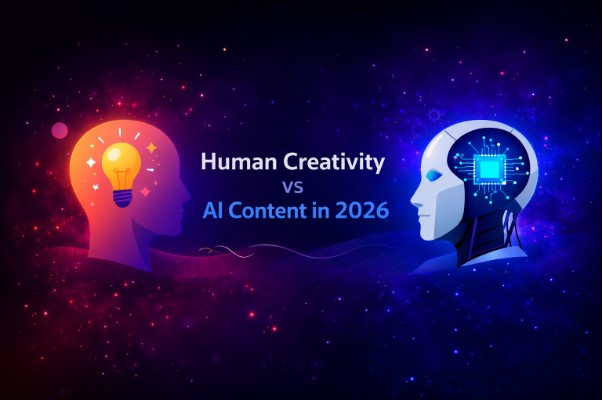
As we move into 2026, audiences are craving something AI alone simply can’t provide – real human emotion, lived experience, and genuine perspective. In this article, we’ll explore why human creativity will continue to outperform AI-only content, and how blending human thinking with smart tools will become the winning formula.
Let’s talk about what truly makes content powerful.
AI Can Write Fast, But Humans Write With Feeling
AI is brilliant at patterns. It looks at billions of words and predicts what should come next. That’s why it can produce clean, structured content so quickly.
But humans don’t read just for information – we read to feel understood.
When someone shares a story about failing in business, struggling with confidence, or finally achieving a goal, it resonates because it comes from lived experience. AI can describe those moments, but it hasn’t felt them. It hasn’t faced rejection, burnout, or self-doubt.
In 2026, content that connects emotionally will stand out more than ever. Readers want warmth, honesty, and relatability – not just polished sentences.
That emotional layer is something only humans can naturally bring.
Trust Comes From Real Voices, Not Perfect Sentences
Trust is becoming the most valuable currency online. With so much AI-generated content flooding the internet, people are becoming more careful about what they believe, share, and buy.
Human-created content builds trust because it carries:
- Personal opinions
- Real-life stories
- Unique experiences
- Honest mistakes and lessons
AI tends to sound confident even when it’s wrong. Humans, on the other hand, can say, “This didn’t work for me – here’s what I learned.” That kind of openness feels real, and readers connect with it.
At the same time, consumer sentiment reflects a growing concern about the reliability of AI-only content, with over 75% of people expressing worry about misinformation from AI-generated material. This highlights why audiences still value human judgment and authenticity in the content they choose to trust. (Source – Forbes)
Brands that use real voices instead of robotic perfection will feel more authentic – and authenticity wins loyalty.
Creativity Isn’t Just Output – It’s Perspective
AI can remix ideas. Humans create meaning.
Two people can experience the same event and describe it completely differently because of their background, beliefs, and emotions. That’s what makes human creativity powerful – it’s shaped by identity, culture, values, and personal journeys.
AI doesn’t have a childhood, a career path, a heartbreak, or a breakthrough moment. It can simulate tone, but it can’t replace perspective.
In the coming years, content that stands out won’t just answer questions – it will offer original viewpoints. And those viewpoints come from human thinking, not data patterns.
Audiences Are Getting Better at Spotting AI Content
Let’s be honest – many people can already tell when something feels AI-written.
It’s usually:
- Too perfect
- Too neutral
- Too generic
- Too safe
Even when the information is correct, it often lacks personality.
As AI becomes more common, human-sounding content will become more valuable, not less. Readers will gravitate towards writing that feels natural, flawed, expressive, and alive – because that’s what real communication feels like.
In 2026, content won’t just compete on accuracy. It will compete on humanity.
Storytelling Will Matter More Than Ever
Facts inform. Stories transform.
AI is excellent at delivering facts quickly. But storytelling – the kind that inspires action – is deeply human. It involves timing, emotion, vulnerability, humour, and intuition.
Think about the articles, videos, or posts that truly stayed with you. They probably weren’t just informative – they made you feel something.
Human storytellers know when to pause, when to simplify, when to share something personal, and when to challenge the reader. AI can follow structure, but it doesn’t understand emotional rhythm.
Story-driven content will outperform formula-driven content, and humans are naturally better storytellers.
Creativity Requires Judgement, Not Just Generation
AI can generate thousands of ideas. But humans decide what matters.
True creativity isn’t about producing more – it’s about choosing wisely. It’s about understanding context, culture, audience mood, timing, and nuance. Humans make judgment calls that AI cannot fully grasp, especially in sensitive or complex situations.
For example:
- Knowing when humour is appropriate
- Understanding cultural boundaries
- Reading emotional tone in feedback
- Adjusting messaging during crises
These decisions require emotional intelligence, not algorithms.
The creators who stand out won’t be the ones who generate the most content – they’ll be the ones who make the best choices.
People Want Conversations, Not Content Factories
The internet is shifting from broadcasting to connecting. Audiences don’t just want information – they want interaction, understanding, and conversation.
Human content invites replies. It asks questions. It shares struggles. It builds community.
AI content often feels like it’s talking at people instead of with them.
In the future, the strongest brands won’t sound like machines – they’ll sound like helpful friends. And that tone can’t be automated fully.
The Future Is Human + AI, Not AI Alone
Let’s be clear – AI is not the enemy of creativity. It’s a powerful tool. It can help with:
- Research
- Brainstorming
- Structuring ideas
- Editing
- Speed
But tools don’t replace thinking – they support it.
The creators who win in 2026 will use AI to work faster, not to think less. They’ll let machines handle repetitive tasks while humans focus on emotion, storytelling, strategy, and meaning.
The real advantage isn’t AI-only content. It’s human-led content, supported by smart tools.
Why This Matters for Businesses and Creators
If you’re running a business, blog, brand, or content platform, this shift is important.
People don’t buy from brands that sound automated. They buy from brands that feel human.
That means:
- Writing as you speak
- Sharing real experiences
- Being honest about challenges
- Showing personality
- Connecting emotionally
In a world full of instant content, human connection becomes the differentiator.
And the brands that understand this will build stronger trust, deeper loyalty, and longer-lasting relationships.
Final Thoughts: Humanity Is the Real Competitive Advantage
AI will keep improving. There’s no doubt about that. It will write faster, smarter, and more fluently.
But creativity isn’t just about fluency – it’s about feeling, meaning, and connection.
In 2026, the most powerful content won’t come from machines trying to sound human. It will come from humans using tools wisely while staying true to their voice.
Your story. Your experiences. Your emotions. Your perspective.
That’s what AI can’t replace.
And that’s exactly why human creativity will continue to outperform AI-only content – not because machines are weak, but because humanity is irreplaceable.